Sajjad and Sons journal
Buying Wrought Iron From Pakistan: What Actually Happens
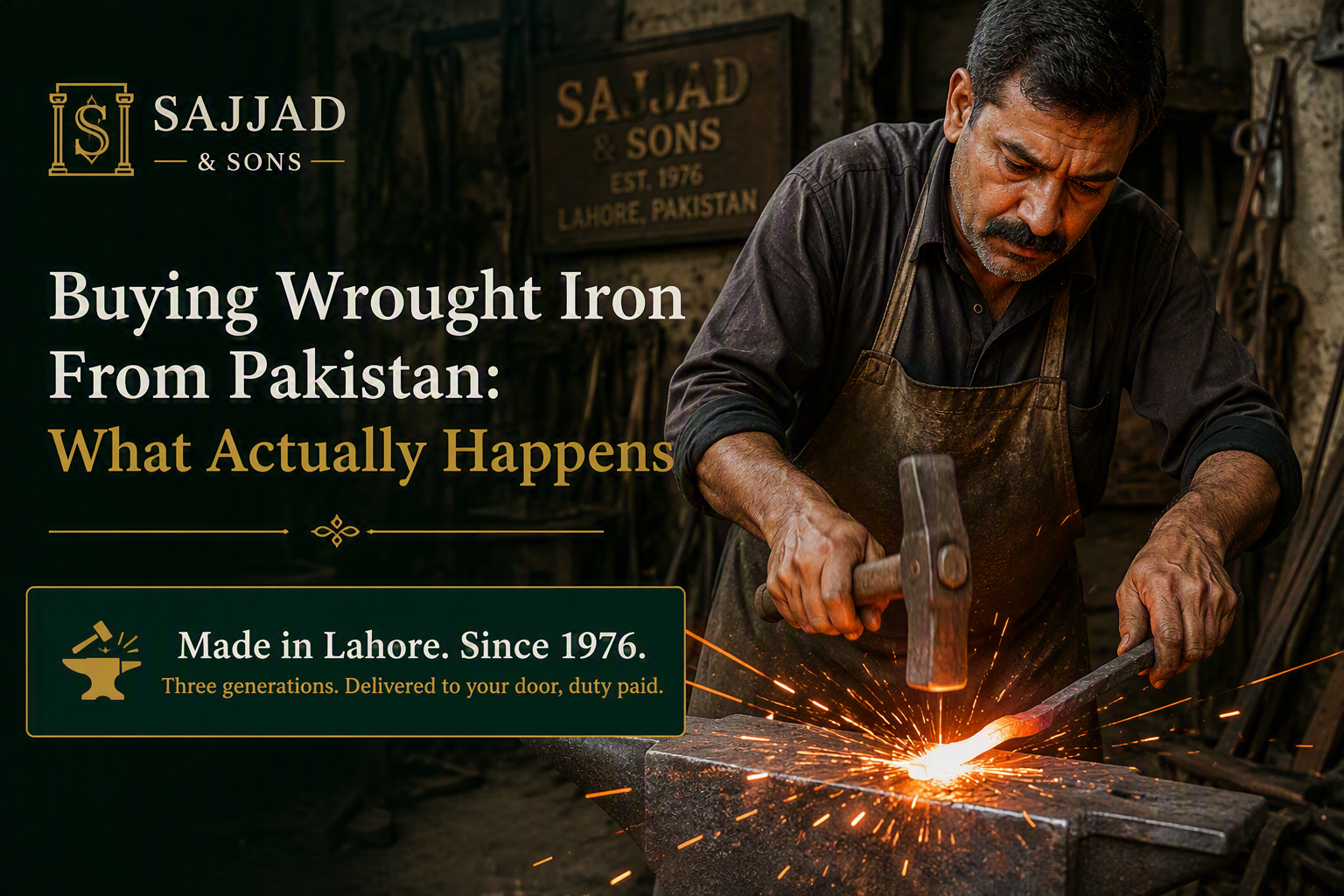
We are a family workshop in Lahore, Pakistan. Three generations, forging since 1976. We make hand-forged wrought iron, cast iron and cast aluminium gates, railings, doors, Juliet balconies and staircases, and we ship them to clients across the United States, Europe, Australia and the Middle East — delivered to the door with freight and duty already paid.
The question we are asked most often, usually politely and sometimes not, is some version of: can I really commission something this significant from a country I have never visited, from people I have never met?
It is a fair question and it deserves a straight answer rather than a sales pitch. So this article describes what actually happens — including the parts that are genuinely different from buying locally, and the parts where you should be careful.
First, what we are not
There is a picture in most people's heads when they hear that ironwork comes from South Asia, and it is worth addressing directly. The picture is of a vast anonymous factory, mass-produced components, a trading company that never touches the goods, and a listing that looks nothing like what arrives.
That industry exists. It is not us, and the differences are checkable rather than merely asserted.
• We are a named family workshop with a fifty-year history, not a trading intermediary. The owner personally quotes every project.
• Every piece is made to order to your design or your chosen design. We do not hold stock and ship you the nearest match.
• Nothing is mass-produced. Scrollwork is forged by hand, and patterns for cast components are made in our own workshop rather than pulled from a catalogue of existing moulds.
• You see your piece at three stages before it ships, and you approve each one.
If a supplier cannot show you their workshop, will not show you work in progress, and will not tell you who is quoting you, those are reasonable things to walk away from — wherever in the world they are based.
What is genuinely different about buying from overseas
Some of it is better and some of it is simply different. Here is the honest version.
It takes longer
A local fabricator can be at your house next week. We cannot. Production takes several weeks in the workshop, and then the piece has to cross an ocean. If you need something in a fortnight, buy locally — we will tell you so ourselves.
What you get in exchange for the wait is a level of hand-work that is difficult to buy at the same price near you, and considerably more design freedom, because a bespoke pattern costs us the craftsman's time rather than a tooling charge.
You cannot walk in and look at it
This is the real difference, and it is why our whole process is built around showing you the work rather than describing it. You see a scale drawing before anything is cut. You see photographs and video of the bare metalwork before it is painted, which is the last stage where a change is cheap. You see it finished in your colour and packed before it leaves.
It is not the same as standing in a workshop. But it is a good deal more than most buyers get from a local supplier, who typically shows you the finished item on the day it is installed.
Fitting is yours to arrange
We do not install outside Pakistan. Your own contractor or fitter does that.
We are direct about this because it is the thing most likely to surprise someone. The piece arrives ready to fix or hang rather than as a kit requiring fabrication, and it ships with drawings, a fixing schedule, an installation guide and care guidance. Where you have a fitter or an engineer, we speak with them during production so the piece is made to be straightforward to install and to suit the code where you are. If you do not have anyone lined up, tell us and we will help you find someone.
Budget for installation separately. It is not included in our price and we would rather you knew that at the start than at the end.
Duty and freight are already paid
This is the part people most often expect to be difficult, and it is the part we have made simplest.
Our international quotations are DDP — delivered duty paid. Freight, export documentation, customs clearance, import duty and delivery to your address are all inside the figure you are quoted. There is no separate invoice on arrival, no broker to appoint, no paperwork for you to file, and no unpleasant surprise at the port.
This is worth checking carefully with any overseas supplier, because it is where costs are most often hidden. A price that looks lower than ours may not include duty, may not include destination handling, and may leave you to clear the goods yourself.
What we ask from you, and what we do not
To give you a firm price we need very little to begin with: a rough dimension and a photograph of the space. Not exact measurements, not a decision on material or finish, not a design brief. Those come later once you know the number.
What we do need eventually, before anything is made, is an accurate set of dimensions, which we confirm back to you on a drawing that you approve. This is the one part where care genuinely matters, and it is why we would rather speak to your fitter than have measurements passed along a chain.
How payment works
On larger commissions, payment is staged against the three approval points rather than taken in advance. Fifty per cent begins the work. Thirty per cent falls due once you have approved the bare metalwork. The final twenty per cent is due when the piece is finished in your colour and crated. Nothing is owed after delivery.
Smaller commissions are payable in advance, simply because three international bank transfers on a small order costs more in charges and time than it is worth to either party.
We are also straightforward about what we are responsible for after delivery. If the material or section used is lighter or of lower value than we quoted, that is on us. If the piece departs from the approved drawing without having been agreed with you during production, that is on us. If there is a manufacturing defect such as a failed weld, that is on us. What is not covered is a change of mind, ordinary handmade variation, a colour difference between a screen and daylight, dimensions that were supplied to us incorrectly, or damage during installation. We would rather set that out plainly than bury it.
Where our work has gone
We have delivered to clients across fourteen countries and four continents. Some of it is ordinary domestic work — a staircase railing, a set of balusters, a garden gate. Some of it is not: two hand-forged estate gates for a private castle in Denmark, ironwork for a church restoration in Poland, full property commissions in the United States.
One of our clients, a property developer in Santa Fe with forty-five years in the industry, put it more plainly than we would: he described the work as flawless and said that if there was any doubt in your mind, you should let it go.
We would rather you did not take our word for it, though. Ask for photographs of work in progress. Ask who is quoting you. Ask what happens if it arrives damaged. A workshop that answers those questions clearly is worth considering wherever it is based, and one that does not is worth avoiding for the same reason.
Frequently asked questions
Is it cheaper to buy ironwork from Pakistan?
Usually, yes — for comparable hand-work, and even with freight and duty included. But compare carefully. Make sure the price you are comparing includes duty, freight, destination handling and delivery, because ours does and many do not.
Do I have to deal with customs?
No. Our international quotations are delivered duty paid, so export documentation, customs clearance, import duty and delivery to your address are all handled and already inside the quoted price.
What if it arrives damaged?
Tell us immediately and photograph it before unpacking further. Transit damage is rare but it happens, and it is dealt with properly rather than argued about.
Will it match the photographs?
You see your own piece photographed and filmed at bare metal and again when finished, before it ships. You are not comparing against somebody else's photograph — you are looking at your own commission.
Who installs it?
Your own contractor or fitter. We do not install outside Pakistan. The piece arrives ready to fix, with drawings, a fixing schedule and an installation guide, and we speak with your fitter during production wherever possible.
How long does it take?
Several weeks in the workshop, then several more in transit, depending on where you are. We give you a realistic timeline with your quotation rather than an optimistic one.
If you have a project in mind, send us a rough dimension and a photograph of the space, and we will come back with a firm price, usually within one to three working days.