Sajjad and Sons journal
Does Wrought Iron Rust? Finishes, Care and What Actually Fails
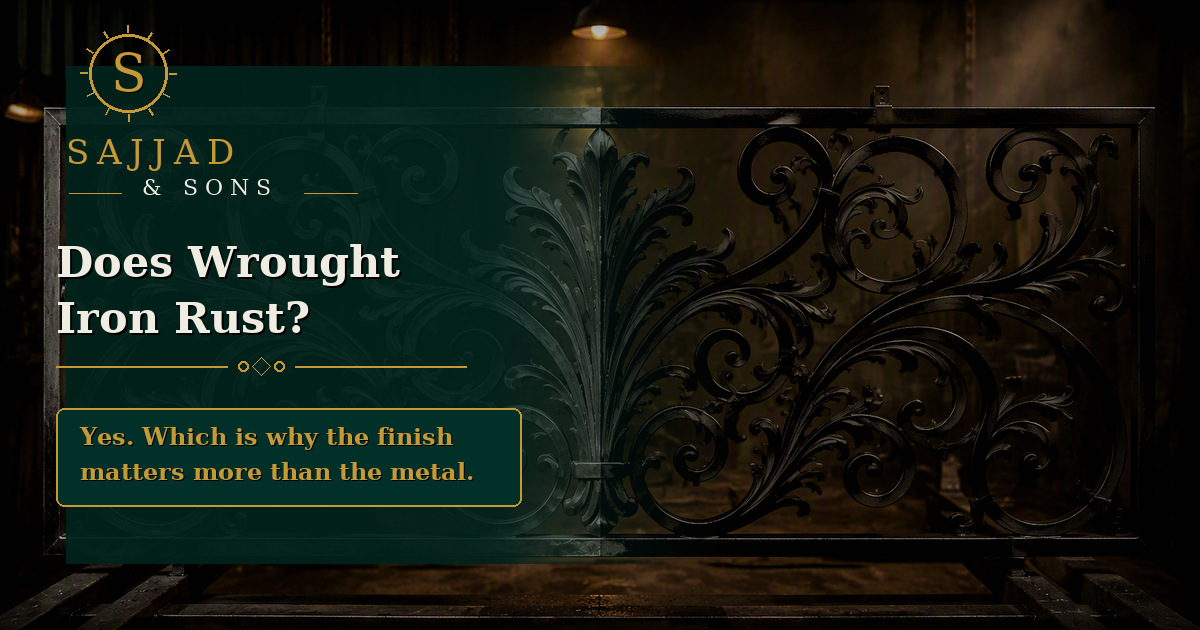
Yes. Iron rusts — it is iron, and given moisture and oxygen it will oxidise. Anybody telling you otherwise is selling something. What actually determines whether your railing is still sound in thirty years is not the metal but the finish on it, and how the surface was prepared before that finish went on.
This matters because almost every piece of ironwork that fails early fails for the same reason, and it is not the reason most people expect.
What actually causes ironwork to fail
Not weather. Not age. Coating damage that nobody dealt with.
A chip, a scratch from a garden tool, a screw hole drilled during installation and left bare, a joint where the coating was thin. Moisture reaches the metal at that one point, oxidation begins, and it spreads underneath the surrounding coating — lifting it from beneath, which is why rust often appears as a blister or a lifted edge long before you see bare metal.
Left alone, that one chip becomes a patch, and the patch becomes a section. Dealt with in the first month, it is a five-minute job with a touch-up brush.
The single most useful thing you can do for ironwork is inspect it once a year and touch up any damage you find.
Why surface preparation matters more than the coating
A coating is only as good as what it was applied to. If mill scale, oil or moisture is left on the steel, the coating adheres to the contamination rather than to the metal, and it will lift regardless of how good the paint itself is.
Preparation is the unglamorous part of the process and the part that is easiest to skip, which is precisely why it is worth asking any supplier about. We do our own surface preparation and coating in house rather than sending pieces out, which means the same workshop is accountable for both.
Powder coating and hand-applied paint
Powder coating
A dry powder is applied electrostatically and then baked, forming a hard, even, durable film. It is tough, consistent, and excellent on large plain areas.
Its limitation is deep ornament. On heavily detailed cast work, powder can bridge fine undercuts or sit unevenly in recesses, and the very hardness that makes it durable also means that when it does chip, it chips cleanly rather than wearing gradually.
Hand-applied decorative paint
Applied and worked by hand, which allows detail to be picked out — a gold accent on a scroll, a two-tone finish on a cast panel, an aged effect. It also touches up almost invisibly, because a hand-applied finish blends where a baked one does not.
Its limitation is that it is less hard than powder, so on a high-traffic handrail it will show wear sooner.
Galvanising and then coating
Zinc applied to the steel before the decorative finish, giving a second line of defence if the top coat is ever breached. It adds cost and it adds a step, and it is worth it in genuinely aggressive environments — coastal, industrial, or anywhere the piece will be regularly wet.
There is no single best answer. A gate in a dry inland climate and a balcony rail two hundred metres from the sea are different problems, and we would specify them differently.
Cast aluminium: the rust-free option
If corrosion is your main concern, cast aluminium removes the problem rather than managing it. It does not rust. It still takes a coating for colour and appearance, but a coating failure on aluminium is a cosmetic issue rather than a structural one.
The trade-off is weight and mass, which for some pieces is part of what you wanted. For coastal properties it is usually the right choice.
How to look after ironwork
Cleaning
• Mild soap and warm water, a soft cloth or sponge.
• Rinse and then dry it. Water left standing in a joint or on a horizontal surface is what starts trouble.
• Never use a wire brush, abrasive pad or scouring powder on a finished surface — you will break the coating and create the problem you are trying to prevent.
• Avoid harsh solvents and bleach-based cleaners.
Annual inspection
• Look along the piece for chips, scratches and lifted edges, particularly at joints, fixing points and anywhere it is touched or knocked regularly.
• Check the bottom of posts and the underside of rails. Damage hides where you do not look.
• On exterior work, check where the piece meets masonry or ground level.
Touching up
• Deal with damage when you find it, not when it becomes visible from a distance.
• Clean the area, remove any loose material gently, let it dry completely, then apply matching touch-up paint.
• Ask us for the finish specification for your piece and keep it. It makes matching straightforward years later.
Care guidance is supplied with every order we ship, so you will have the specific instructions for your piece and its finish.
A note on repairs
We do not repair or restore existing ironwork — we make new pieces. We are saying so plainly because people ask, and being sent on a long conversation before hearing no is a waste of your time.
What we can tell you is that most rust damage on otherwise sound ironwork is a finishing problem rather than a structural one, and a competent local painter or metalworker can usually put it right at far less cost than replacement. It is worth getting that assessed before assuming a piece is beyond saving.
Frequently asked questions
Does wrought iron rust?
Yes. It is iron. The finish and the surface preparation beneath it are what determine how long it lasts, not the metal itself.
How do I clean wrought iron without ruining the finish?
Mild soap, warm water, a soft cloth, then rinse and dry it. Never use a wire brush, abrasive pad or harsh chemicals on a finished surface.
How do I remove rust from wrought iron?
On light surface rust, clean the area gently, let it dry completely and apply matching touch-up paint. For anything more extensive, have it assessed by a local metalworker or painter.
Is powder coating better than paint?
It is harder and more consistent, which suits large plain surfaces. Hand-applied paint suits deep ornament and touches up almost invisibly. Which is better depends on the piece and where it is going.
What about galvanising?
Zinc applied before the decorative coating gives a second line of defence if the top coat is breached. It is worth the extra cost in coastal, industrial or persistently wet environments.
Will cast aluminium rust?
No. If corrosion is your main concern, cast aluminium removes the problem rather than managing it.
If you are choosing a finish for a project, tell us where the piece is going and how exposed it will be, and we will specify it honestly.