Sajjad and Sons journal
Inside Our Workshop — Sajjad & Sons, Lahore: A Look at Three Generations of Hand-Forged Ironwork
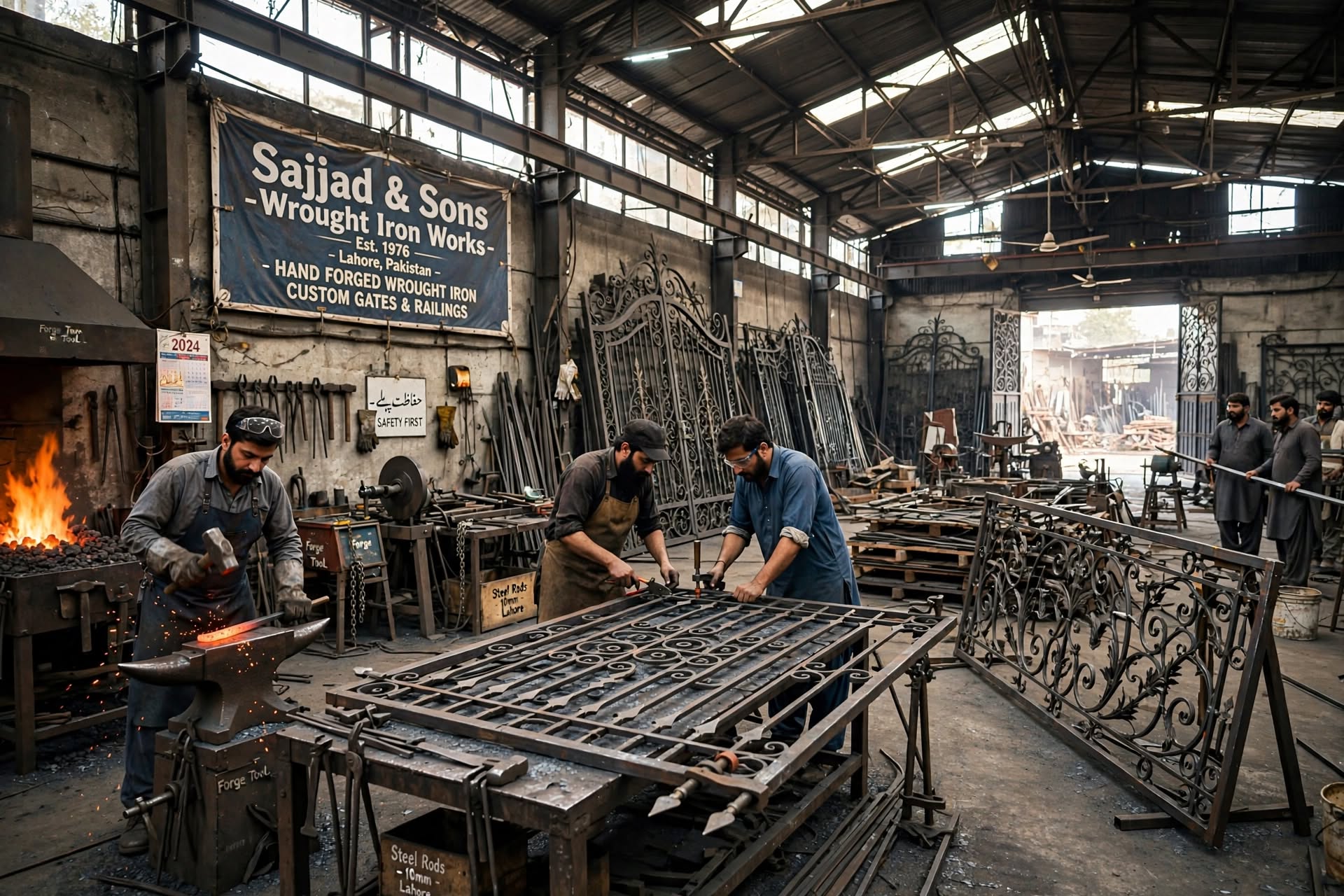
Inside Our Workshop — Sajjad & Sons, Lahore
Step inside the workshop where three generations of hand-forged ironwork tradition come together, one hammer strike at a time. This raw, unedited footage takes you behind the scenes of Sajjad & Sons, a family-run metalworking house in Lahore, Pakistan, where wrought iron, cast iron, cast aluminum, and mild steel are shaped into gates, railings, staircases, doors, and balconies that ship to homes and buildings across the world.
There is no script here, no polish, no studio lighting. What you're watching is a real day in a real workshop — the same place where every custom order, from a single Juliet balcony to a full estate gate, begins its life as raw metal before it becomes something a family will walk past every single day for decades.
Our Story: Three Generations, One Craft
Sajjad & Sons was founded in 1976 in Lahore, Pakistan, and has remained a family business ever since. What started as a small metalworking operation has grown, generation by generation, into a workshop trusted by clients not just across Pakistan but internationally — in the United States, across Europe, and in Australia.
There's something that doesn't change when a craft is passed down through a family rather than taught in a classroom. Knowledge here isn't written in a manual — it's transferred hand to hand, from father to son, from master craftsman to apprentice, refined over decades of trial, correction, and pride in the work. Every gate that leaves this workshop carries that inheritance. It's not just metal being bent into shape; it's a family's name being put on the line, piece after piece, for close to fifty years.
That's the story this video is really about. Not just "how ironwork is made," but why a family keeps making it, generation after generation, when it would be far easier to mechanize, standardize, and mass-produce. The answer, if you watch closely, is in the hands you see in this footage — steady, practiced, unhurried, because rushing a piece of iron never makes it better.
What You'll See In This Video
This tour walks you through the working areas of the Sajjad & Sons workshop in Lahore — the spaces where raw material is measured, cut, shaped, joined, and finished into the ironwork our clients ultimately receive. You'll see the day-to-day reality of a working metal shop: tools laid out and in use, pieces at various stages of completion, and the unglamorous but essential process that sits behind every finished gate or railing you might see in a photo or a finished installation.
We chose to publish this footage unedited and without narration on purpose. Anyone can post a polished highlight reel. Fewer businesses are willing to show you the actual working conditions their products come from. If you're considering commissioning a custom piece — whether it's a staircase railing for a home renovation or a full estate gate — we think you deserve to see exactly where and how that piece will be made before you commit to it.
The Craft of Wrought Iron and Custom Metalwork
Wrought iron work is one of the oldest metalworking traditions in the world, and the fundamentals haven't changed much even as tools have modernized. A design starts as a concept — sometimes a client's own sketch, sometimes a reference photo of a style they love, sometimes a completely custom idea developed between the client and our team. From there, the piece has to be measured precisely against the space it will occupy, because unlike factory-made railings or gates sold in fixed sizes, everything we make is built to the exact dimensions of the opening, staircase, or balcony it's going into.
Once dimensions are confirmed, raw material — iron, steel, or aluminum depending on the piece — is cut, shaped, and formed according to the design. Scrollwork, decorative panels, and structural elements are built up piece by piece and joined together, whether that's through traditional forge-welding techniques or modern welding methods, depending on what the design and structural requirements call for. Ornamental details — the curls, the floral motifs, the geometric patterns you often see in wrought iron balconies and gates — are added and refined by hand, because no machine reproduces the slight asymmetries and organic feel that make hand-forged ironwork look different from something stamped out in a factory.
After the structural work is complete, the piece moves to finishing — grinding down welds, smoothing edges, and preparing the surface for whatever finish the client has requested, whether that's a matte black powder coat, a bronze or gold leaf accent, or a raw natural steel finish for an industrial look. Quality control happens at every stage, not just at the end, because a flaw caught early is a five-minute fix; a flaw caught after painting is a much bigger problem.
This is, at its core, slow work. It has to be. Ironwork that's going to stand outside a home for the next thirty or forty years, exposed to weather, handled daily, and expected to still look and function beautifully, doesn't get there by cutting corners.
Our Product Range
While this particular video focuses on ironwork, our workshop produces a wide range of custom metalwork and building products. Our core specialty — and the reason most international clients come to us — is bespoke ornamental ironwork:
Wrought iron gates, from single pedestrian gates to grand double driveway entrances
Cast iron and cast aluminum staircase railings and balustrades, for both interior and exterior use
Spiral staircases, custom-built to fit the exact height and footprint of the space
Juliet balconies and French balconies, popular with clients renovating older or historic-style properties
Custom entrance doors, security grills, and window grills
Decorative panels, gates, and fencing for landscaping and boundary walls
Beyond ironwork specifically, Sajjad & Sons also works across a broader range of home improvement and building trades, including home decor pieces, landscaping elements, general metal and aluminum fabrication, epoxy resin work, solid wood products, and electrical work. Ironwork remains our lead offering and the area where we've built the deepest expertise and international reputation, but if you have a broader project in mind — say, a full renovation involving multiple trades — it's worth asking, since we may be able to help coordinate more of it than you'd expect from an ironwork specialist.
Materials We Work With
Different projects call for different materials, and part of what a good custom metalwork shop offers is guidance on which material actually fits your project, your climate, and your budget — rather than pushing whatever is easiest to produce.
Wrought iron is prized for its strength, its traditional forged appearance, and the way it takes ornamental detail — the scrollwork and decorative flourishes associated with classic European and colonial-style ironwork are almost always wrought iron or a wrought-iron-style fabrication.
Cast iron offers a different aesthetic and is often used where a heavier, more sculptural look is desired, particularly in staircase balustrades and larger decorative elements. Cast aluminum has become increasingly popular for clients who want the ornamental look of cast ironwork without the weight or the long-term maintenance that iron requires in humid or coastal climates — aluminum doesn't rust, which matters enormously for outdoor installations in places like Florida, coastal Australia, or anywhere with high humidity.
Mild steel rounds out our material offering and is typically used for more contemporary, minimalist designs — clean lines, geometric patterns, and industrial-style railings and gates that prioritize structural simplicity over ornamental detail.
Why Bespoke Matters
There's a meaningful difference between buying a gate or railing off a showroom floor and commissioning one built specifically for your space. Off-the-shelf products are built to standard sizes and have to be adapted — sometimes awkwardly — to fit whatever opening they're going into. A bespoke piece starts from your exact measurements and your exact vision, which means no gaps, no forced compromises, and no settling for "close enough."
It also means the design itself can be entirely yours. If you've seen a style you love in a photo, a piece from another project, or even something you sketched yourself, we can work from that reference rather than asking you to choose from a limited catalog of pre-set options. This is particularly valuable for clients working on historic homes, architecturally distinctive properties, or spaces with unusual dimensions where standard products simply won't fit or won't look right.
The tradeoff, of course, is time. Bespoke ironwork isn't something you can order today and receive tomorrow — it has to be designed, quoted, approved, and then hand-built from scratch. But for a piece that's meant to last for decades and be a genuine architectural feature of your home rather than just a functional necessity, most of our clients find that tradeoff more than worth it.
Shipping Worldwide — What DDP Means for You
One of the questions we're asked most often by international clients is how shipping actually works, and specifically what "DDP" means, since it comes up in almost every quote we send.
DDP stands for Delivered Duty Paid. In plain terms, it means the price we quote you is the full and final price — it already includes production, international freight, and all customs duties and import taxes at your destination. You are not going to receive a surprise bill from customs, and you are not going to be asked to handle import paperwork yourself. The piece arrives at your address, duties already settled, ready to be installed.
We ship internationally to clients across the United States, Europe, and Australia, in addition to serving clients within Pakistan. Because every piece is custom-built rather than pulled from stock, there is a production timeline before shipping even begins — depending on the complexity and size of the piece, production typically takes several weeks, followed by several more weeks of international transit. We always communicate realistic timelines upfront during the quoting process, because we'd rather set accurate expectations than surprise a client later with delays.
International shipping of large, heavy ironwork is genuinely complex — it involves careful packaging to prevent damage in transit, correct documentation for customs in the destination country, and coordination with freight partners who understand how to move oversized cargo safely. This is a big part of what separates an experienced international ironwork exporter from a local shop that's never shipped outside its own city. We've built relationships with freight partners specifically because of how often we ship this kind of product internationally.
How to Get a Quote
If something in this video catches your eye, or you have your own project in mind, the process to get started is simple. Send us a reference photo or a sketch of the design you're picturing, along with the width and height (or overall dimensions) of the space it needs to fit, and let us know your city or delivery address. From there, we'll get back to you with a price — typically within 24 hours for straightforward requests.
For larger or more complex projects — say, a full property that needs several types of ironwork, or a project where you're not entirely sure yet what you need — it's also completely fine to reach out with just a general idea. We're happy to walk through the options with you before anything is finalized.
The easiest way to reach us is directly on WhatsApp, where you can send photos, ask questions, and get a response quickly without having to fill out a long contact form first.
Frequently Asked Questions
Do you ship to my country? We regularly ship to the United States, across Europe, and to Australia, in addition to serving local clients in Pakistan. If you're located somewhere else, it's still worth reaching out — international shipping logistics vary by destination, but we've handled a wide range of delivery locations.
How long does a custom piece take? Timelines depend on the size and complexity of the design, but as a general guide, production typically takes several weeks, with international shipping adding several more weeks on top of that. We'll give you a specific estimate as part of your quote once we understand the exact scope of your project.
Can you build from a photo I found online or on Pinterest? Yes — this is actually one of the most common ways clients start a project with us. Send us the reference image along with your measurements, and we'll quote based on recreating that style for your specific space.
What's the difference between wrought iron, cast iron, and cast aluminum? Broadly, wrought iron is prized for strength and fine ornamental detail; cast iron offers a heavier, more sculptural aesthetic; and cast aluminum gives a similar ornamental look to cast iron without the risk of rust, which makes it a popular choice for humid or coastal climates. We can advise on which material best fits your specific project and location during the quoting process.
Do you only do gates and railings? No — our core specialty and international reputation is built on ornamental ironwork including gates, railings, staircases, and balconies, but our workshop's capabilities extend into broader home improvement, decor, and building trades as well.
Is everything really made to order, or do you have any stock items? Everything is bespoke and made to order based on your specific design and measurements. We don't carry a stock catalog of pre-made pieces, which is part of why every project starts with a conversation about your exact needs.
Why Trust Sajjad & Sons
Trust in a business you can't visit in person has to come from somewhere, and we understand that international clients in particular are taking a leap of faith when they commission a custom piece from a workshop on the other side of the world. This video exists specifically to help close that gap. Rather than asking you to take our word for it, we wanted you to be able to see the actual workshop, the actual working conditions, and get a sense of the real operation behind the finished photos you may have seen elsewhere.
Nearly fifty years in business, spanning three generations of the same family, is not something that happens by accident or by cutting corners. It happens because clients — locally and internationally — keep coming back, keep referring friends and family, and keep trusting us with pieces that will be part of their homes for decades.
Follow Our Journey
If you'd like to see more of our work, follow along on our other platforms, where we regularly share completed projects, works in progress, and behind-the-scenes looks at the workshop:
Website: sajjadandsons.com
Instagram: instagram.com/sajjad_and_sons
Facebook: facebook.com/sajjadandsons
Pinterest: pinterest.com/sajjadandsonsltd
Get In Touch
Ready to start your own custom ironwork project, or just have a question about what's possible? We'd love to hear from you.
WhatsApp: +92 301 2596491
Email: info@sajjadandsons.com
Website: sajjadandsons.com
Send us a photo, tell us your sizes, and let's build something that lasts.
#WroughtIron #CustomIronwork #BespokeMetalwork #Lahore #Pakistan #IronRailings #IronGates #HandForged #MetalworkingShop #IronworkWorkshop #JulietBalcony #FrenchBalcony #SpiralStaircase #CastIron #CastAluminum #MildSteel #HomeImprovement #InteriorDesign #ArchitecturalIronwork #DDPShipping #InternationalShipping #FamilyBusiness #ThreeGenerations #CustomGates #EstateGates #StaircaseRailings #MadeToOrder #OrnamentalIronwork #BlacksmithLife #WorkshopTour #BehindTheScenes