Sajjad and Sons journal
How You Approve Your Ironwork Three Times Before It Ships
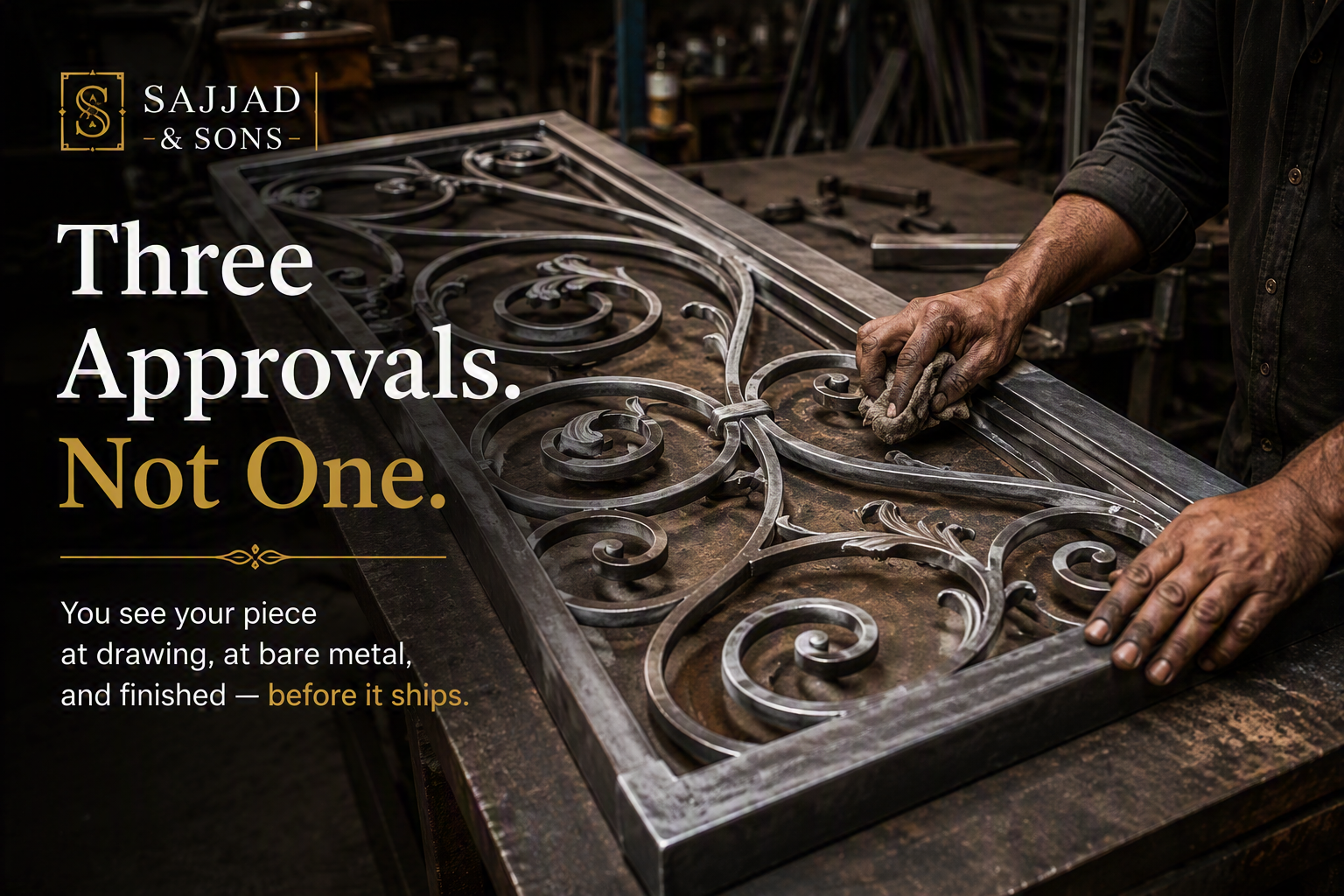
You approve your piece three times before it leaves our workshop: once at the drawing, once at bare metal before it is painted, and once finished in your colour and packed for shipping. If anything is wrong at any of those stages, we change it.
This exists for a straightforward reason. Commissioning something large, expensive and permanent from a workshop on another continent asks a great deal of trust from a person who has never met us and cannot walk in and look at the bench. Photographs at the end of the process are not enough, because by then a change is expensive and everyone involved knows it.
So we do not ask you to take anything on faith. We show you the work three times, at the three moments where seeing it actually changes what you can do about it.
The first approval: the drawing
Before any steel is cut, you receive a drawing of your piece to scale, showing the dimensions we have worked to.
What you are checking here is proportion. A pattern that looks beautiful in a photograph of somebody else's staircase can look crowded or sparse on yours, because your opening is a different size. Scrollwork that fills a four-foot panel handsomely may look thin across seven feet. This is the stage to say "that looks too busy" or "I expected the centrepiece to be larger."
It is also where we confirm your measurements back to you in a form you can check against the actual opening. More fitting problems are caught here than at any other point.
Nothing is cut until you are satisfied with the drawing.
The second approval: bare metal, before paint
This is the one almost nobody else offers, and it is the one that matters most.
When the piece has been forged and assembled but before it goes anywhere near the paint line, we photograph and film it and send it to you. Steel at this stage is still workable. A scroll can be reshaped, a bar can be cut and re-forged, a panel can be widened or tightened. Once a piece has been coated, all of that becomes expensive — you are stripping finish, reworking metal and refinishing.
So the bare metal stage is the last genuinely cheap moment to change your mind, and we would rather you used it than discovered something six weeks later on a delivery vehicle.
What clients typically check here:
• Whether the scrollwork spacing looks right at full size, rather than on paper.
• Whether the piece is the weight and substance they expected — sections and bar thickness are very visible in bare steel.
• Whether the dimensions match what they measured.
• Whether a decorative element they were unsure about actually works.
We have had clients ask for a twist to be made looser, a scroll to be opened out, or an ornament to be repeated more often along a run. All of those are simple changes in bare metal and awkward ones afterwards.
The third approval: finished and packed
When the piece is complete in your chosen colour and finish, you see it again — photographed and filmed, and then packed.
What you are checking here is the finish. Colour is the single thing that photographs least reliably, and a shade that looks right on a paint chart can read differently in daylight against your existing ironwork. If you are matching something you already have, this is the stage to say so.
You also see how the piece has been packed. Most of our work travels in a purpose-built timber crate, treated to the ISPM-15 international standard, built around the piece rather than the piece being fitted into a box. Smaller items are packed and boxed where a crate is unnecessary, and very large commissions occasionally ship uncrated because a crate simply will not fit in the container — in that case the piece is wrapped, protected at every contact point and braced inside the container. We tell you which applies to your order before it leaves.
Why it is built this way
We are a family workshop in Lahore, three generations, forging since 1976. We ship to clients across the United States, Europe, Australia and the Middle East, and almost none of them have stood in our workshop.
What we have learned is that the questions clients actually worry about are not really about craft. They are: will it be the right size, will it be the right colour, and will it arrive. The three approvals answer the first two directly, and they answer them at the moments when the answer can still change something.
There is a second effect, which is that it keeps us honest. A workshop that has to show you bare metal before painting cannot quietly use a lighter section than it quoted. Our standing rule is that we never use a material or section lighter or of lower value than we quoted. We will substitute upward at no extra cost where it genuinely suits the piece better — a heavier bar because the proportion works better at finished size, for example — but never downward. Showing you the bare metal is what makes that rule checkable rather than merely stated.
How payment follows the approvals
On larger commissions, payment is staged against those same three moments rather than taken up front.
Fifty per cent begins your commission and puts it into the workshop. Thirty per cent falls due once you have seen and approved the bare metalwork. The final twenty per cent is due when the piece is finished in your colour and crated for shipping. Nothing is owed after delivery.
Smaller commissions are simpler and are payable in advance — three international transfers on a small order costs more in bank charges and time than it is worth to either of us. Your quotation states which applies to your project.
The approvals themselves apply to every commission at every size. They cost nothing and they are simply how the workshop works.
What happens after it ships
Your piece travels to your door with freight and duty already paid, so there is nothing to arrange and nothing to settle on arrival. We handle export documentation, customs clearance and duty through our agent in your country.
We do not fit ironwork outside Pakistan. Your own contractor handles installation, and the piece arrives ready to hang or fix rather than as a kit needing further fabrication. Drawings, a fixing schedule, an installation guide and care guidance ship with the ironwork. Where you have a fitter or engineer, we speak with them during production so the piece is made to be straightforward to install and to meet the code where you are.
Frequently asked questions
What if I want a change after seeing the drawing?
Then we change the drawing. Nothing is cut until you have approved it, so a change at this stage costs nothing but time.
What if I want a change after seeing the bare metalwork?
Most changes are still straightforward at that stage — that is precisely why we show you. Reshaping a scroll, adjusting a twist or altering spacing are ordinary work in bare steel. If a change is substantial enough to affect the price we will tell you before we begin it.
Can I see the piece being made, not just the finished stages?
Yes. We send progress photographs and video at key points and are happy to send more if you would like them. Some clients want a steady stream; others prefer just the three approval stages. Tell us which you are.
What if the colour is not right when I see the finished photographs?
We repaint it. That is the entire purpose of showing you the finish before the piece is packed.
Do the three approvals apply to small orders too?
Yes. The approvals apply to every commission regardless of size. Only the payment structure differs.
If you have a project in mind, send us the rough dimensions and a photograph of the space and we will come back, usually within one to three working days.