Sajjad and Sons journal
Wrought Iron, Cast Iron, Cast Aluminium or Steel: Which and Why
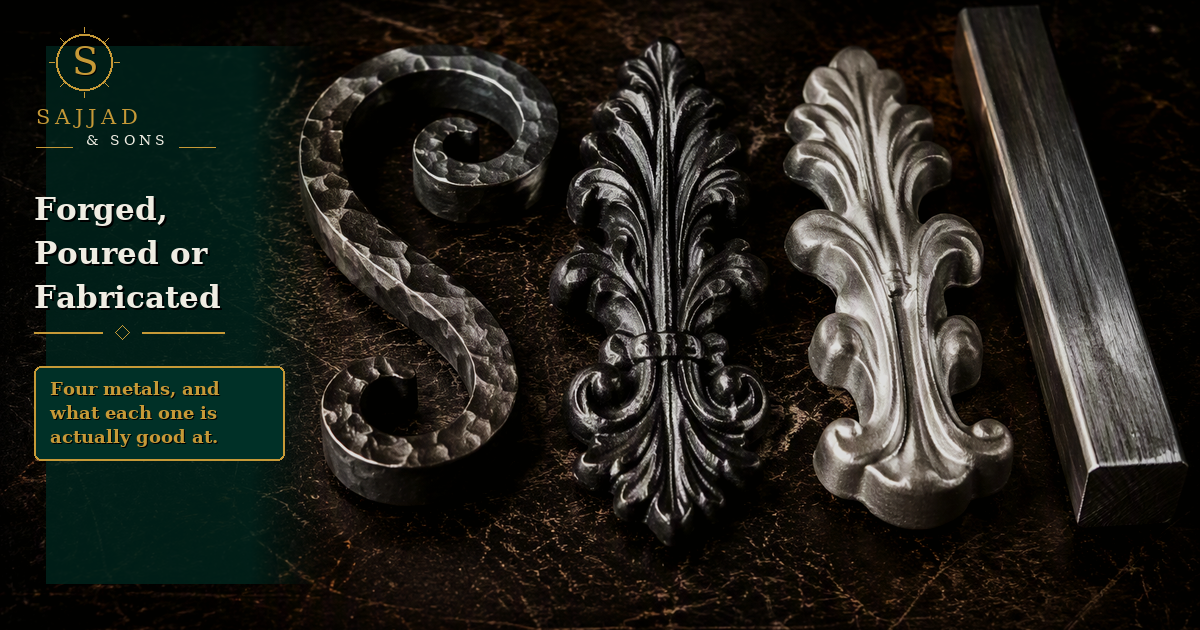
The difference is how the metal is shaped. Wrought iron is worked hot by hand — hammered, bent and twisted. Cast iron and cast aluminium are melted and poured into a mould. Mild steel is fabricated: cut, welded and assembled. We use all four, for different reasons, and most of our commissions combine two or more of them.
The words get used loosely, including by people selling the stuff. “Wrought iron” in particular is often used to mean nothing more specific than “black metal railing.” So here is what the terms actually mean, and what each material is genuinely good at.
Wrought iron: worked by hand, hot
Wrought means worked. A bar is heated in a forge until it is soft enough to shape, then hammered, drawn, bent and twisted by a craftsman. Every scroll is made rather than moulded, which is why no two hand-forged scrolls are identical and why the surface carries the marks of the tools that shaped it.
What it is good at: flowing, organic shapes. Scrollwork, twists, tapers, leaf forms. Anything where the line should look drawn rather than assembled. It also takes repair and alteration well, because it can be reheated and reworked.
What it is not good at: fine three-dimensional detail repeated many times. If a design needs the same intricate rosette forty times, forging each one by hand is slow and they will not match. That is a job for casting.
Cast iron: poured into a mould
Molten iron poured into a mould made from a pattern. The pattern is the skilled part — for our work, patterns are made in our own workshop rather than pulled from a catalogue of existing moulds, which is what allows a genuinely bespoke cast component such as a family crest or a monogram.
What it is good at: fine, deep, repeated three-dimensional detail. Floral panels, medallions, crests, rosettes, ornamental capitals. Anything where the same intricate element appears many times and must be identical.
What it is not good at: flexing. Cast iron is hard and brittle rather than tough. It is used for ornament and for components under compression, not for the structural frame of a gate.
Cast aluminium: poured, but light and rust-free
The same casting process, in aluminium instead of iron. It takes detail nearly as well, weighs considerably less, and does not rust.
What it is good at: coastal and humid locations, and anywhere long-term corrosion resistance matters more than absolute strength. Also useful where weight is a problem — a large gate leaf in cast aluminium puts far less load on its hinges and posts than the same design in iron.
What it is not good at: taking heavy impact, and situations where the sheer mass of iron is part of what you want. A cast aluminium estate gate is a sensible choice; a cast aluminium security barrier is not.
Mild steel: the structure behind the ornament
Steel is iron with a controlled carbon content, produced in standard sections and fabricated by cutting and welding. It is strong, predictable and readily available in consistent sizes.
What it is good at: the structural frame. The rails, stiles and posts that carry the load and hold everything square. Most of our gates are a mild steel structural frame carrying forged and cast ornament — which is the sensible way to build them.
What it is not good at: nothing, within its role. But steel alone, with no forged or cast work, is what produces the flat, machine-made look that people are usually trying to avoid when they come to us.
So which should your project be?
In practice it is rarely one material. A typical ornamental gate from our workshop is a mild steel frame, hand-forged scrollwork, and cast components for the repeated decorative elements. The choice worth making consciously is usually iron versus aluminium for the cast parts.
Choose iron if
• The piece is inland and not exposed to salt air.
• You want the weight and presence of iron — it is noticeably heavier in the hand and on the hinge.
• The design is traditional and you want the material to match the period.
Choose cast aluminium if
• You are near the coast, or in a humid climate.
• Long-term corrosion resistance matters more to you than mass.
• Weight is a constraint — a wide gate leaf, an existing post you do not want to replace, or an upper-floor balcony.
If you are unsure, tell us where the piece is going and what it has to do. Recommending the wrong material to make a sale is a false economy for both of us, because it comes back as a complaint.
A note on the word “wrought”
Historically, wrought iron also described a specific material — a low-carbon iron with a fibrous slag content, made by a process now largely obsolete. Almost nothing sold today as wrought iron is that material. What the term now describes, and what we mean by it, is ironwork that has been worked by hand at the forge rather than poured or machine-bent.
It is worth knowing because it explains why “wrought iron” appears on products that are clearly stamped and machine-formed. The word has become a style description. When we use it, we mean the process.
Frequently asked questions
What is the difference between wrought iron and cast iron?
Wrought iron is shaped by hand while hot — hammered, bent and twisted. Cast iron is melted and poured into a mould. Wrought iron suits flowing shapes and scrollwork; cast iron suits fine repeated three-dimensional detail such as medallions and crests.
What is the difference between wrought iron and steel?
Steel is produced in standard sections and fabricated by cutting and welding, which makes it ideal for the structural frame. Wrought ironwork is shaped by hand at the forge and is what produces the ornamental character. Most of our pieces use both.
Is it “rod iron” or “wrought iron”?
Wrought iron. “Rod iron” is a common mishearing — “wrought” is pronounced like “rot.” Both terms are searched for constantly and mean the same thing to most people using them.
Does cast aluminium look cheaper than iron?
Not once it is finished. It takes fine detail nearly as well as iron and holds a coating well. The visible difference is weight rather than appearance.
Can you combine materials in one piece?
Yes, and we usually do. A mild steel frame with forged scrollwork and cast ornament is the standard construction for our gates.
Tell us what you are making and where it is going, and we will recommend the material honestly — then come back with a firm price, usually within one to three working days.